
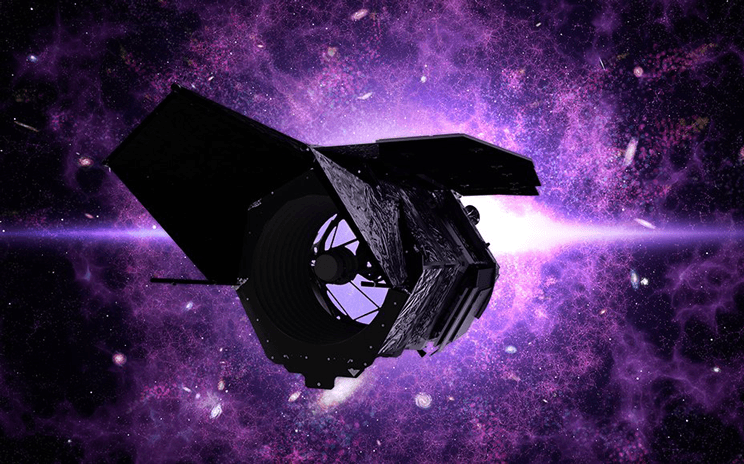
Roman Space Telescope (RST)
The Nancy Grace Roman Telescope has a 7.9 feet or 2.4 m primary mirror. It has a 300-megapixel, wide-field camera for imaging and spectroscopy and an advanced coronagraph for hunting exoplanets. Its five-year mission will be conducted while the spacecraft is orbiting the L-2 Sun-Earth position.
While under development, the telescope was called the Wide Field InfraRed Survey Telescope (WFIRST). It was renamed in 2020 in honor of Nancy Grace Roman, NASA’s first Chief of Astronomy. Roman has been called the "mother" of NASA’s Hubble Space Telescope due to her tireless "mission" encouraging NASA and the astronomical community to create an important optical telescope.
Launch and Current Status
The Nancy Grace Roman Space Telescope was launched by a Falcon Heavy on August 30, 2026. Shortly after launch, the solar panels in the Solar Array Sun Shield were successfully deployed. On August 31, the first of two planned mid-course burns was conducted. The high gain antenna was deployed along with the "deployable aperture cover" or sun visor.
On September 1, the Coronagraph Instrument was powered up. On September 14, NASA announced that RST has fuel for at least 22 years of scientific operations due to savings on launch weight and a very successful mid-course burn. On September 15, the Wide Field Instrument was activated.
☆ ☆ ☆
The Roman Space Telescope will establish a Sun–Earth L2 orbit about 100 days after launch.
⋆ ⋆ ⋆
Roman Telescope Optical Assembly
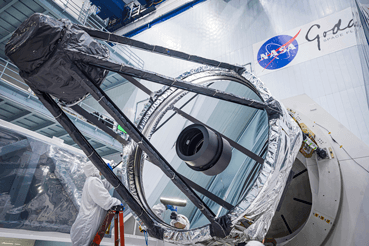
Credit: NASA/Chris Gunn
Even though the Roman telescope and the Hubble telescope have the same size mirror of 2.4 meters, the Roman telescope has a much wider field of view due to advanced optics and software. While Hubble can only take images of ~2.5 arc-sec, or about half the size of a full moon, the Roman telescope makes images at least 100 times larger than Hubble's. It will be used to study dark matter, dark energy, the Milky Way galactic bulge, and search for exoplanets working in the near-infrared and optical wavelengths.
The Roman telescope is a survey instrument; that means it covers large areas of the sky. Data from the Roman telescope will be available as soon as it is processed. The Hubble Space Telescope works in the near ultraviolet, visible, and near-infrared while Roman focuses mainly in the infrared. RST's sensitivity starts at .5 microns and ends at 2.3 microns. Roman complements James Webb that works from 2.4 to 5 microns in the infrared. Both Roman and Webb telescopes orbit the Sun near the Sun–Earth L2 Lagrange point, about 1 million miles or 1.5 million km from Earth, in a halo orbit. That is, when the Roman telescope establishes its final orbit.
⋆ ⋆ ⋆
Roman Telescope Instruments
Wide Field Instrument (WFI)
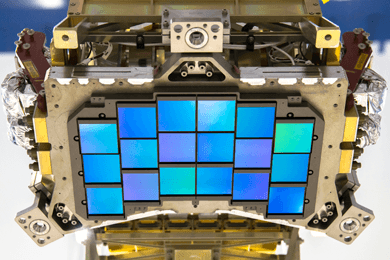
The Wide Field Instrument (WFI) is Roman’s primary science instrument and enables large scale surveys. It has a 300-megapixel visible-to-NearInfraRed imaging camera and slitless spectrometer. The WFI has 18 detectors covering a 0.8 degree x 0.4 degree or 0.281 deg2 field of view.
Cold Sensing Module (CSM)
Key components are housed in the Cold Sensing Module including the Focal Plane Assembly, the Simplified Relative Calibration System (sRCS) and the Element Wheel.
Focal Plane Assembly (FPA)
The FPA contains an array of 18 sensors (HgCdTe) detectors is arranged in slightly curved rows. It is a 300-megapixel focal plane array utilizing 18 individual 4K x 4K detectors providing a field of view 100 times larger than the Hubble Space Telescope.
Simplified Relative Calibration System (sRCS)
Built by NASA Goddard, the sRCS inside the CSM acts as an internal light-source to test detector sensitivity. The diffuser is shaped like a sphere and made out of spectralon. Light sources inside it can shine through the spectralon sphere. Scientists can use the Lamp On Lamp Off (LOLO) method for calibrating during their obseravtion. Calibration ensures the camera measures the relative brightness of galaxies and supernovae to a precise 0.1% accuracy.
Element Wheel Assembly (EWA)
Before reaching the detector array, light from Roman’s optical system encounters the Element Wheel Assembly (EWA). The EWA is a rotating wheel that contains multiple filters for imaging and spectroscopy. There are eight science filters - one wide band, and seven more narrow filters. It carries a high-dispersion grism and lower-dispersion prism assemblies for wide-field slitless spectroscopy. The eleventh slot uses spectralon for calibrations. As a filter, it is called "dark". Calibrating the telescope will provide high-quality images in various wavelengths over the total spectral bandwidth of the instrument.
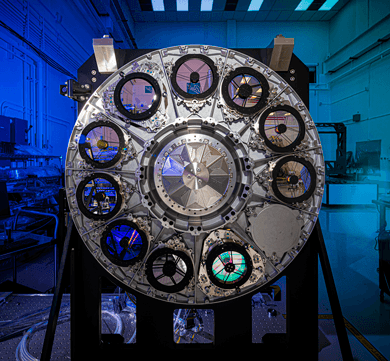
The Focal Plane Array has two dispersive elements for slitless, multi-object spectroscopy. Using filters and spectroscopy from the grism and prism, the WFI will study galaxies and supernovae to help us understand dark energy.
Grism
The bandpass spans 1.0 – 1.93 microns. The Grism spectrograph uses a grid.
Prism
The bandpass spans 0.75 – 1.80 microns. The Prism uses a prism to perform spectroscopy.
Warm Electronics Module (WEM)
The WEM provides instrument commanding and mechanism control.
☆ ☆ ☆
Coronagraph Instrument (CGI)
Coronagraphs block light from a bright object, like the Sun or a star, to detect fainter objects. The CGI will be used to directly image planets and disks around other stars, called "exoplanets". The Coronagraph Instrument is a technology demonstration for future missions that will advance our ability to directly image Earth-like exoplanets. It is a "tech demo" that will help to advance future coronagraph technology for ground-based and space-based instruments.
NASA says, "The Roman Coronagraph is a system of masks, prisms, detectors and even self-flexing mirrors built to block out the glare from distant stars and directly image the planets in orbit around them."
On RST, the coronagraph uses various masks to block portions of the field, such as the central star and telescope structures to observe the field surrounding the target star. It uses off-axis mirrors to detect and conduct light through the instrument and prisms for polarization and spectroscopy. Self-flexing or deformable mirrors can change shape due to tiny pistons that change the mirror's shape from behind. The two deformable mirrors are 2 inches or 5 cm across and are adjusted by 1600 actuators. The CGI has wavefront sensors that enable the deforming mirrors to create the correct shape for the current observation. This system cancels out the shaking of the instrument due to changes in temperature during observations.
The CGI works from 546 nm to 866 nm from blue area into the infrared (NIR) of the electromagnetic spectrum. The technology demonstration lasts for three months and will operate within the first 1-1/2 years of the Roman Telescope's operations in space.
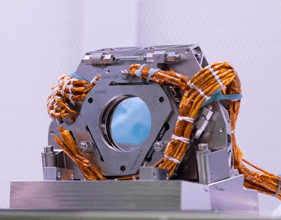
Fast steering mirrors like the one above, make the Roman coronagraph possible. The mirror can make small movements to correct for slight wobbling of the observatory. This makes the incoming image sharp. Then the masks can suppress light from a star but allow the light from planets or dust orbiting it to pass through. Roman should be able to directly image Jupiter-sized exoplanets in orbit around a star. The star must be single, no brighter than 5th magnitude, and be 2mas (milliarcseconds) in apparent diameter.
☆ ☆ ☆
Find out more about Roman instruments:
WFI Reference Information - and Coronagraph - from Science at NASA
Roman Coronagraph Primer - dated January 8 2025
The Roman Space Telescope's Wide Field Instrument - from NASA Goddard YouTube channel
⋆ ⋆ ⋆
Nancy Grace Roman
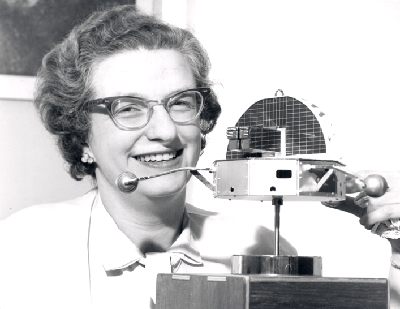
Known sometimes as the "Mother of Hubble" , Nancy Grace Roman was hired by NASA in 1959 to help set up the Office of Space Science. In 1960, she was made the Chief of Astronomy, the first woman to hold an executive position at NASA. Nancy was instrumental in developing the agency’s many space telescopes.
The picture here shows Nancy with a model of the Orbiting Solar Observatory (OSO). Nancy was in charge of the OSO program. It consisted of 8 satellites, the first one successfully launched in February 1962 and was designated OSO-2.
Other astronomical satellites that Nancy Roman oversaw reads like a list of who's who of orbital astronomical observatories. Among these include the Small Astronomy Satellite series: SAS-1,the X-ray explorer Uhuru; SAS-2, a gamma ray observatory that discovered Geminga an interesting gamma source; SAS-3, an X-ray telescope named Copernicus. She was involved with Infrared Astronomy Satellite (IRAS), Cosmic Background Explorer (COBE), and International Ultraviolet Explorer (IUE). She was also involved with astronomical experiments on Spacelab, Gemini, Apollo, and Skylab. Nancy also led NASA’s airborne astronomy program, putting telescopes on airplanes. This enabled NASA to fly a 12-inch telescope on a Learjet and a 36-inch telescope for the Kuiper Airborne Observatory. She even helped to put astronomical experiments on balloons.
Read Nancy Grace Roman's biography on Astra's Biographies of Extraordinary Women page
⋆ ⋆ ⋆
On-line Resources
Nancy Grace Roman Space Telescope - NASA Science Mission page of the Roman Space Telescope
Roman Science Support Center at IPAC - from the Caltech Infrared Processing and Analysis Center (IPAC)
Nancy Grace Roman Space Telescope - NASA's Roman mission blog
Explore the Roman Systems - NASA
This interactive webpage is loaded with information as well as diagrams that show where various parts of the Roman telescope are located on the spacecraft system.
Find more images at NASA's Nancy Grace Roman Space Telescope Flickr page.
Glossary and acronyms - Roman User Documentation - Roman telescope acronym list
This NASA Science page can help with those confusing, over used acronyms. This is part of NASA's Roman User Documentation. On the left-hand side of the page there are links to surveys, instruments, proposals, and even more technical data for astronomers and researchers.
Educational Activity Center - link to NASA education activities for the Roman Space Telescope
Nancy Grace Roman Telescope - by Atomic Laboratory on Instagram. It's a nice Roman telescope infographic.
Hubble, Roman and Webb Space Telescopes Infographic - from NASA Scientific Visualization Studio
NASA Scientific Visualization Studio compares three current space telescopes: The Hubble, The James Webb and the Nancy Roman telescopes. The infographics can be downloaded for use in other presentations.
NASA explains: "Hubble views the cosmos in infrared, visible and ultraviolet light, providing a more comprehensive, high-resolution view of individual objects. The Roman Space Telescope will expand on Hubble’s infrared observations specifically, using a much larger field of view to create enormous panoramas of the universe with the same high resolution. Webb will also conduct high-resolution infrared observations, peering across farther stretches of space with a narrower field of view."
This webpage is ©2026 D. E. Jenkins all rights reserved. Please use the contact page to get permission to use this content or to send comments or corrections.
Last Modified 09/20/2026
Links to other Stargate Pages:
- Astronomy |
- Space |
- StarWimin |
- NE Asteroids |
- Ancient Astronomy |
- Observers |
- What's Up? |
 Return to Astra's Stargate home