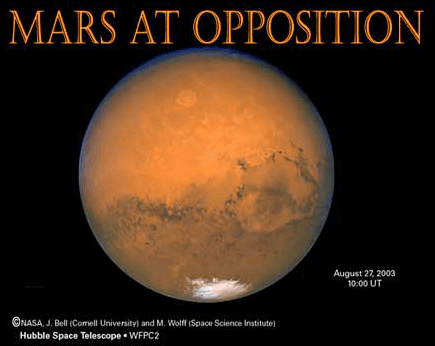
Mars Opposition 2027
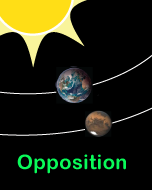
The best time to observe Mars is when it is on the opposite side from the Sun as viewed on Earth as it will be on the night of February 19, 2027. The disk of Mars will be 13.8 arc-seconds and shine at -1.3 magnitude. The planet will be located in the constellation of Leo. On this night, Earth catches up with Mars again and moves between it and the Sun. Use this link to jump to the night of opposition on this page.
Because of its distance and small size, Mars can be a difficult planet to find in the night sky. At times it may appear only as bright as a second magnitude star. Just before opposition Mars becomes very bright and shines all night after the Sun sets. At this time, the two planets will be closest to each other in their orbits. Earth observers can see the full disk of Mars until dawn.
Mars emerges from conjunction in January 2026 but is not readily observed until October 14, 2026 when the red planet is only 1.3 magnitude and the disk is 6" in diameter. Mars is in the constellation of Cancer and rising around 1:40 am. But a new apparition has begun and Earth and Mars march toward opposition. This is the 2026-27 apparition of Mars that continues until once again the red planet disappears behind the Sun in March 2028.
Previous Opposition: January 16, 2025 ☆ ☆ ☆ Next Opposition: February 19, 2027
The close approach between Earth and Mars at opposition is not unusual, but part of a regular cycle that the two planets established many years ago. Every 780 days, or roughly 2 years and 50 days, planet Earth passes Mars on its orbital track, overtaking the red planet. Opposition occurs when Earth is directly between the Mars and the Sun. Just before opposition Mars will be very bright and shine all night after the Sun sets and present a full disk until dawn.
The Earth's orbit is very nearly circular, but Mars' orbit is more eccentric, that is, it varies 0.093 from circular. This means the red planet is much closer to the Sun at perihelion (206 million km) than at aphelion (249 million km) a difference of 43 million km. In comparison, the difference between Earth's aphelion and perihelion distance is 5 million km. These distances vary, of course, and I have used extremes. But those differences mean the distance between Earth and Mars at opposition is variable. The count of 780 (actually 778 days) is considered Mars' "synodic" period. Because of the speed of their orbits Earth travels for 2 years, plus an extra 50 days or so when it catches up again with Mars.

The Earth/Mars opposition cycle can be seen in the diagram. The 2027 opposition is shown at the right, represented by the disks of Earth and Mars. The image shows the solar system as though we are looking down on the Sun's north pole. Although the orbits are shown here with some accuracy, the images of the Sun, Earth, and Mars are not drawn to scale. Both Earth and Mars are shown with the north pole tipped toward the Sun. Other oppositions are represented by blue and red dots. The orbits are both marked with apsides ("a" = "aphelion" and "p" = "perihelion") and the first point of Aries. This marks the 0-degree point for RA in Earth coordinates and therefore helps to orient the orbit. The Earth-Mars opposition cycle repeats for 7 oppositions over a period of 15.8-years. When the cycle has completed 3 times (after 237 or so years) the cycle starts over and the planets again reach opposition at very similar positions where they met in order for 21 times.
In 2027, Mars' will be located in the constellation of Leo at opposition and it will be at the minimum magnitude for Mars during opposition. This opposition is considered an aphelion opposition because Earth will pass Mars when the red planet is nearest to its aphelion (farthest from the Sun). Review the information on Astra's Mars Oppositions page for more information on types of oppositions. Mars is inclined to its orbit with an axial tilt of 25.2 degrees and it points its southern hemisphere toward the Sun during perihelic oppositions. Mars' orbital motion near perihelion is faster than at aphelion so there is a greater distance between perihelic oppositions as compared to the aphelic oppositions. Mars' orbit and axial tilt means that southern summers are shorter and hotter than southern winters. This can be seen in the opposition diagram above. The seasons are not equal: summer in the north lasts 182 days, while southern summers are 160 days. The seasonal differences mean that Mars north polar cap is larger than the southern cap so the southern cap may disappear completely during a perihelic opposition.
February 19 Opposition
The February 19, 2027 opposition of Mars is an aphelion opposition when Mars is reaching opposition from Earth during farther points in its orbit around from the Sun. Better oppositions are called perihelion oppositions because Mars is closer to the Sun in its orbit. If Mars is further away from the Sun, it is also further away from Earth when Earth overtakes the slower moving planet. This opposition occurs when Mars is very close to its actual aphelion position.
Mars reached its perihelion on March 24, 2026, long before Earth could catch up to it. The planet will hug the horizon, making it hard or impossible to see until later in June 2026. but the disk of Mars will be only 4.1 arc-secs. (This is quite small for amateur instruments! Going forward we will use the " symbol to represent the measurement.) Mars will actually reach aphelion on March 2, 2027, long after opposition. Keep in mind that planets move a lot slower when near aphelion. Mars will be closest to the Earth on February 20, that is the day after the actual moment of opposition. At that time the distance between the two planets will be .6779 astronomical units (AU) or 63,016,511 miles or 101,415,244 km. After opposition, the Earth will speed away from the red planet, only to meet up in March of 2029.
During the 2026-2027 opposition, Mars will be 0.8 arc-sec smaller than it was in the 2025 opposition. Mars will be 9.4 degrees lower in the sky than it was in 2027, a more comfortable height for many observers. Mars will shine in the constellation of Leo, but will have competition from Jupiter. Jupiter just passed its own 2027 opposition on February 11. Shining at -2.5 with a 44.2" disk diameter, Jupiter outshines Mars at -1.3 mag. and a diameter of 13.8"
☆ ☆ ☆
Path of Mars for the 2026 - 2027 Opposition
MARS begins 2026 at solar conjunction, in the constellation of Sagittarius. On March 26, Mars reaches perihelion when it begins to appear in the morning twilight. In mid-April, the red planet whizzes past Saturn and dances with Mercury and the Moon in the constellation Aquarius. Unfortunately, we cannot observe this due to the fact that Mars is too close to the Sun along the horizon.
On July 4, Mars catches up with Uranus in the constellation of Taurus, for a close approach, visible in the early morning. They will be separated by a mere 6.3', with Mars shining at 1.3 mag and Uranus at 5.8 mag. This may be the planetary conjunction of the year, so grab a scope for early morning astronomy. In October, Mars plunges into the Beehive cluster, entering on the 10th and crossing in two days. On October 11, Mars has a conjunction with Asellus Australis, a 4th magnitude star, designated Delta Cancri. The Beehive Cluster covers 1.5 degrees of the sky, about 3 full moons. On October 14, Mars reaches a disk diameter of 6" and the 2026-2027 opposition of Mars will officially begin. This is because a 6" diameter makes it possible for small instruments to see details on the planetary disk.
On November 16, Mars (0.7 mag.) will pass 1.2 deg. above Jupiter (-2.1 mag) in the constellation Leo. On November 19, 2027, Mars will be at Western Quadrature, when the positions of the Sun, Mars, and Earth make a 90-degree angle. On November 24, Mars passes 1.8 deg. N. of Regulus or Alpha Leonis. Mars will be visiting Regulus again as it moves around Leo during this opposition. It is a good time to compare the colors of Jupiter, Mars, and Regulus. By year's end, Mars will be -0.1 mag. and have a 10.3" disk. The time of the next opposition is approaching.
On January 10, 2027, Mars reaches its first stationary point and begins traveling in retrograde. Mars' apparent motion is backward, and the planet moves westward in the sky. At this time the disk is 11" in diameter and is 94.4-percent illuminated. The north pole will be facing the Sun during this opposition.
Just before Mars reaches the moment or position of opposition, it will pass below stars making up the mane of the lion, they are part of an asterism called, "the Sickle" To the observer, the highest star is Adhafera or Zeta Leonis (+3.44 mag). It is an optical double star with 35 Leonis, a 6.8 magnitude star. A second pair of stars forming part of the sickle, Gamma Leonis, named Algieba is a binary star system, made up of two red giants.
The moment Mars is exactly at opposition is February 19, 2027 at 15:45 UT. The red planet is located deep in the heart of the constellation Leo, shining at magnitude -1.3. The disk of the planet is 100- percent illuminated. It is 63 million miles or 101.4 million km away from Earth at opposition. February 20, Mars at closest approach (00:07 UTC) will be just a bit closer than it was the night of opposition. On February 26, Mars has a conjunction with Al Jibha or Eta Leonis a 3.4 mag star, at that time, Mars will shine at -1.2.
On April 1, 2027, Mars secondary stationary point is reached and it ends retrograde motion and resumes normal eastward path. On May 15, Mars is in conjunction with Regulus again. It is now 89.9-percent illuminated and shining at -0.42 magnitude. On May 26, 2027, Mars reaches eastern quadrature. By the end of June 2027, Mars disk has shrunk to 6 arc-seconds and the opposition of Earth and Mars is over. In early July, Mars slips out of Leo and moves into Virgo. Mars reaches solar conjunction on March 21, 2028.
Mars' Path Through Leo 2026 / 2027
During the 2027 apparition, Mars moves through the constellations of Leo and Cancer. As viewed from Earth, a loop through the constellation Leo occurs as Mars appears to move backward, that is from East to West. During this apparition the loop is closed, because Mars will appear to cross its own path.
Mars reaches its first stationary point on January 10, 2027 and begins retrograde motion. At this time the disk of Mars will be 11" with the North Polar Cap visible. Now Mars continues to travel backward and gains brightness, reaching -1.3 magnitude on February 19, when it will be at opposition at 1545 UT. But the planets move on and six weeks later, Mars reaches its second stationary point on April 1, when it will be at -0.35 magnitude. Mars returns to its regular path as if it never traveled backward at all.

Stationary and Retrograde Points
Mars and other outer planets appear to change their direction in the sky as the Earth speeds past them. As Mars goes about its normal orbit, it appears to move through the constellations on the ecliptic in a regular pattern from West to East. This is contrary to the motion of the stars that move from East to West as the Earth rotates. So during the months around opposition, Mars becomes bright, calling attention to itself for astronomers or anyone looking up who can see that bright red warrior. The difference between Mars at its farthest distance and when Earth is passing it is greater than it is for any other planet. At first Mars seems to behave as usual, but then it does a little dance, and starts to move in the opposite direction or retrograde motion.
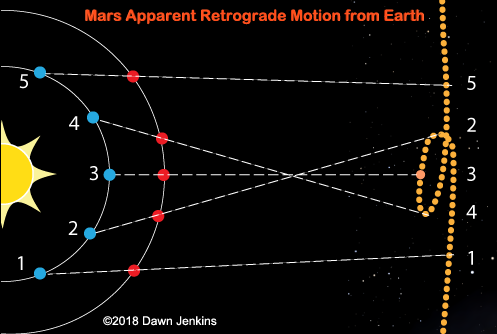
Before retrograde motion begins, Mars seems to stand still. This can be thought of as Earth, coming around the curve of its orbit so that Mars appears to quit moving. This is merely our line-of-sight. It's like being on a train when it is being passed by a faster train. If you are looking out the train window, suddenly you feel like you are moving backwards. Earth and Mars are doing something like that, the blue planet is lapping the red planet on their orbital tracks. On January 10, Mars hits its first stationary point, indicated on the diagram with the number 2. After that it travels in a backward direction (East to West) that is called "retrograde". The night of opposition is February 19, 2027 when Mars will shine at -1.3 magnitude. (position 3) Now the Sun is directly behind the Earth and Mars is 180-degrees away from it. On April 1, 2027 Mars comes to its second stationary point (position 4). Soon Mars resumes its normal course in the sky against the background field of stars that is called "prograde". It's important to remember that Mars never does anything but continue to revolve in its usual counterclockwise orbit. It is only our line-of-sight that makes it seem to move in a loop or sometimes an ess-curve against the background stars.
At position 5, Mars has been left behind and both planets orbit the Sun until their mutual speeds and positions reunite them for the next opposition. The Mars disk shrinks and will continue to do so until Mars disappears behind the Sun in March 2028. The date of conjunction is March 21, 2028.
Mars Disk Size
The first disk of Mars on the chart below represents the size and magnitude of the Mars when it first emerged from behind the Sun in January 2026. This tiny disk represents the view of Mars when it is far from Earth, presenting a small disk, not quite 4" in diameter. As can be seen, the disk will not grow to the grand size it did in 2018, but instead it will present the smallest disk on the chart. From the northern hemisphere, astronomers will have a good image of Mars because it is at a nice height in the sky.
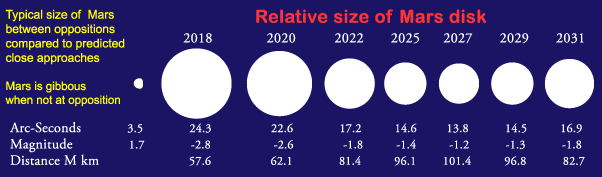
By February 2027, the disk of Mars will grow to the about the size noted here for the 2026-2027 opposition. The disk of Mars will be 100% illuminated as observed from Earth. At its closest, the actual disk of Mars will be 13.8", the largest it will be for the opposition of 2027. Because a large disk will give a better resolution, images will be made by amateurs and professional astronomers alike. Of course, an instrument with a larger aperture will reveal more details on Mars but amateurs with small instruments will be rewarded.
Mars is expected to shine at -1.3 magnitude on the date of opposition, far less than it was during perihelic oppositions. Its disk will then begin to shrink as Earth pulls away from the red planet. By April 1, 2028, about seven weeks later, the disk will be about 11.4". At that time Mars will shine about -0.36 magnitude.
Some helpful links
For more in depth information on Mars at opposition, go to Astra's Mars Oppositions page.
Find out which side of Mars is visible while you are out viewing the red planet through a telescope. Sky & Telescope magazine features an interactive application, Mars profiler. Use this tool to find out what side of the martian surface is currently in your viewfinder or check up on the time of your observation.
A.L.P.O. MARS Section - American League of Planetary Observers
The 2026-2027 Aphelic Apparition of Mars - by Jeffrey D. Beish.
Sadly, Jeff passed in 2025. His work is maintained by the ALPO Mars section.
Mars reaches opposition in February 2027, the best time to see the Red Planet - BBC Sky at Night magazine
Opposition of Mars - Nakedeyeplanets.com - by Martin J. Powell
Naked Eye planets is a excellent resource for anyone interested in observing Mars or other planets in the solar system. A very detailed description of the path that Mars takes during an opposition is available at the site.
Mars at Opposition (2027) In-the-sky.org
Edited by Dominic Ford. Customizable star charts are available this site, for Mars and other objects.
B.A.A. Mars Section - British Astronomical Association
Hubble Space Telescope Images of Mars
Mars in opposition in 2018 (annotated) - Labels features visible shortly before opposition when there was a dust storm
Stormy Mars in opposition in 2018 - About 2 weeks before closest approach
Mars 2016/2018 side-by-side - Show how different Mars looked in 2016 from 2018 due to dust storm and Mars-Earth circumstances
Animation of difference in Mars orientation, 2016 and 2018 - This shows how different seasons on Mars change the planet's appearance for Earth observers. Because the south pole is pointing toward the Sun, Hellas Basin can be seen more clearly during perihelion apparitions.
One last image that I really love because Saturn was at opposition a month earlier than Mars. The year 2018 brought 3 oppositions in quick succession including Jupiter at opposition May 9. This image shows that Hubble Space Telescope is a planetary instrument as well as a deep sky marvel:
For more observation tips go to this article: What's up article/observing Mars.
For drawing help check here: What's up article/drawing Mars.
Last Opposition: January 16, 2025
To find out about Earth's missions to Mars, go to Astra's Mars Exploration page.
If you love the red planet as much as Astra does, check out the Astra's Stargate main page on Mars, the 3 Faces of Mars page!
 Return to Astra's Stargate Home