NASA's Swift Observatory Needs a Boost
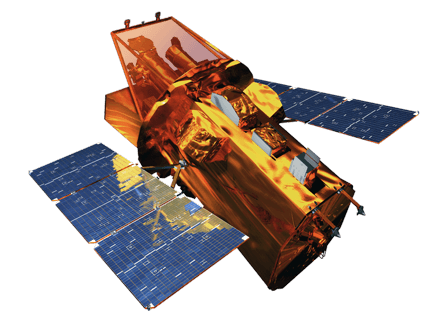
Credit: NASA E/PO, Sonoma State University/Aurore Simonnet
Launched in 2004, NASA’s Neil Gehrels Swift Observatory has been struggling in a decaying orbit that was caused by recent high-energy outburst by the Sun. The spacecraft has no thrusters to lift itself into a higher orbit and it faces destruction. The instrument was launched on November 20, 2004 and has given over 20 years of service and important astronomical information. For most satellites, this would signal the end of the mission and the space agency would let the forces of nature run their course.
The Swift telescope is unique. It was designed to detect Gamma Ray Bursts, short-lived but high-energy explosions, heavy in gamma-ray but also active at other wavelengths. Using its wide-field Burst Alert Telescope (BAT), Swift studies the sky for gamma ray activity. When a burst is detected, the onboard computer calculates its position and slews the entire spacecraft to study the object with narrow-field instruments, the X-Ray Telescope (XRT) and Ultraviolet/Optical Telescope (UVOT) that immediately begin gathering data on the object. Swift spins without assistance from the ground and can begin studying the outburst with its high-precision instruments within 90 seconds. The telescope has continuously supplied data for the Swift/BAT Hard X-Ray Survey and the Swift XRT Cluster Survey (SWXCS), mapping the X-ray sky.
LINK to the Rescue
Instead of letting the telescope burn up in the atmosphere, NASA decided this was an opportunity to test on-orbit servicing technology by sending a spacecraft to raise Swift’s orbit. The agency contracted Katalyst Space Technologies to build and launch a robotic servicing mission. Katalyst built the LINK satellite to link with the Swift telescope that has no gear for on-orbit servicing. After LINK is close to Swift it will perform the rescue maneuver using autonomous sensors and three robotic arms to link with Swift. Once the spacecraft are joined, LINK's thrusters will re-boost Swift to its original altitude of ~364 miles or 585 km. If successful, the maneuver will extend Swift’s gamma-ray research by several years and usher in a new era for servicing spacecraft on orbit.
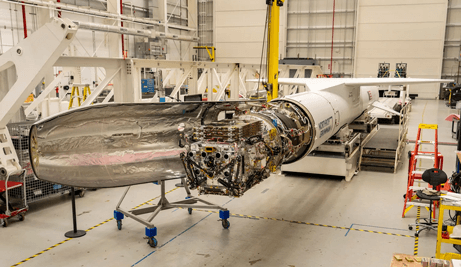
Credit: NASA/Ron Beard
NASA shared this image of Katalyst Space’s LINK robotic servicing satellite before loading on Northrop Grumman's Pegasus XL on June 8, 2026, at NASA’s Wallops Flight Facility in Virginia. LINK will attempt to boost the orbit boost of NASA’s Neil Gehrels Swift Observatory before the end of the month.
This mission will help NASA prepare for a Hubble Space Telescope servicing mission in the future. The spacecraft was serviced by astronauts and the space shuttle which of course, is no longer available. The aging telescope has been operating since The Hubble Space Telescope was launched on the Shuttle Discovery (STS-31) on April 24, 1990. It was serviced on five subsequent Shuttle missions and is expected to operate into the mid 2030's.
Launching LINK
The LINK spacecraft will be launched the Marshall Islands in the South Pacific Ocean on Northrop Grumman's Pegasus XL in mid-June 2026. Pegasus XL can carry payloads up to ~1,000 pounds or 450 kilograms. The Pegasus XL was the first United States air-deployed orbital launch vehicle and the first commercially developed launcher. It launched many scientific satellites for NASA.
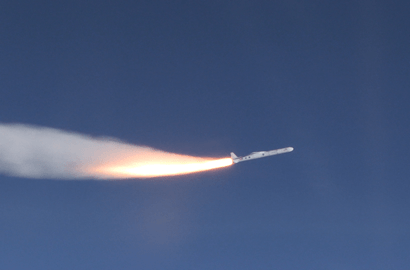
Credit: NASA
The last of its kind, Pegasus XL has one mission last planned for 2026. Launch is set for June 27, 2026. This should be a heroic flight for an old workhorse.
Pegasus will be launched on Northrop Grumman’s Stargazer, a modified L-1011 aircraft. After takeoff, Stargazer will lift the rocket to ~40,000 feet and release it. While in free-fall, Pegasus fires its first-stage rocket motors. It usually takes about 10 minutes to deliver its payload into orbit.
LINK will take over a week to catch up with Swift in its orbit. LINK will take images of the telescope and ground controllers will study its condition and plan exactly how they will grab Swift with LINK's three robot arms. Once the satellite telescope is properly secured, LINK will use thrusters to return Swift to its 585-kilometer orbit. Once Swift is back in place, LINK will release it, allowing the veteran satellite to continue discovering new Gamma Ray Bursters.
A successful mission will open up a new era for NASA - - satellite servicing.
⋆ ⋆ ⋆
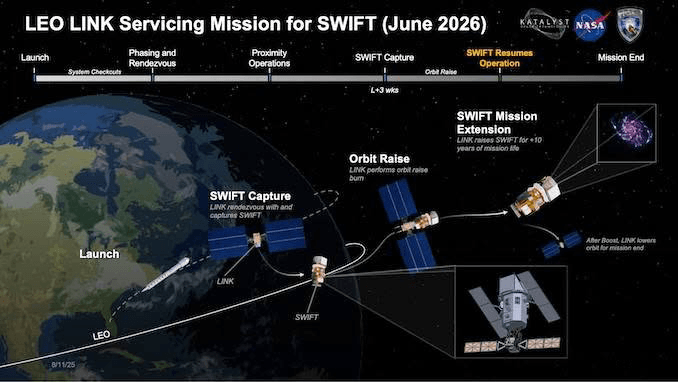
Credit: NASA/Katalyst Space Technologies infographic
⋆ ⋆ ⋆
SWIFT Boost Mission Updates
SWIFT boost mission launched on Friday, July 3, 2026, 4:36 am EDT
On July 28, NASA reported two of LINK’s three reaction wheels were not operable, and there was some loss of functionality in its cold gas thruster system. LINK lost attitude control and began to spin, nine degrees per second.
By August 5, the spin rate was reduced to 1.47 degrees per second, NASA still has hope that the Swift rescue can be successful. Slowing the spin required use of the spacecraft's propellent.
⋆ ⋆ ⋆
Get Mission updates from NASA on the Swift Blog
⋆ ⋆ ⋆
The Telescope and Instruments
The telescope was originally launched in November 2004 on a Delta II launch vehicle from Complex 17A at Cape Canaveral Air Force Station. The spacecraft needed a 20-degree orbit to avoid the Southern Atlantic Anomaly, an area of Earth's surface with a lower magnetic field that doesn't protect Earth from radiation from the Van Allen Belts. The orbit was necessary to protect the instruments operating at very short wavelengths. Because it launched at 28- degrees latitude, the Delta rocket made use of its ability to shut down and relight its upperstage engines to make a series of orbital maneuvers that require extra fuel.
Swift's original low-earth orbit took it about 92 minutes to complete, passing above and below the equator. It moves in a circular orbit with a perigee about 364 miles or 585 km above the Earth. The orbit began drifting downward during the sun's solar maximum in 2024, caused by intense solar activity that caused Earth’s atmosphere to expand slightly and increased its drag on the Swift spacecraft. NASA predicted that Swift would re-enter by the summer of 2026. Today, the telescope is at 232 miles or 373 km above Earth when it is at its closest.
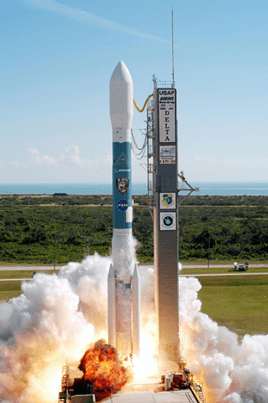
Credit: NASA
In 2018, the Swift telescope was renamed the Neil Gehrels Swift Observatory after Neil Gehrels, the principal investigator of the Swift telescope project who died in February 2017.
Instruments
- Burst Alert Telescope (BAT) - operating at 15-150 keV
- X-Ray Telescope (XRT) - operating at 0.3-10 keV
- Ultraviolet/Optical Telescope (UVOT) - operating at 170-650 nm
⋆ ⋆ ⋆
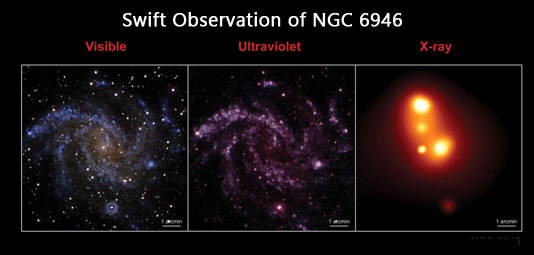
Twenty-one years of surveys and service has enabled Swift to spot the farthest burster, the brightest burster, X-ray flares coming from a galactic nucleus, and many other wonders. NASA reports it has observed over 1,800 GRBs and 1,400 supernovae, and with results that have been used in over 6,000 publications. To illustrate results coming from the three instruments, here is one of Astra's favorite galaxies, NGC 6946. This image was extracted from a NASA poster of galaxies observed by Swift.
In October 2022, Swift detected a giant gamma ray emission originating from the direction of the constellation Sagitta. This Gamma Ray Burster (GRB 221009A) traveled an estimated 1.9 billion years to reach Earth. Even at that distance it had as much affect on the Earth's atmosphere as the solar wind. The universe is an incredible place so maybe we can't afford to turn our back on it. The burster was jointly discovered by Swift Telescope and the Fermi Gamma-ray Space Telescope. The burst was so intense, astronomers have called it the "BOAT" or the "Brightest Of All Time". It is considered a once-in-10,000-year cosmic blast, or as Astra would say, "Being at the right place at the right time."
⋆ ⋆ ⋆
Off-site Resources
Swift - NASA Science Mission page of the Neil Gehrels Swift Observatory
Swift Boost - NASA PDF about the Swift Boost with basic Swift facts and other mission resources
The Neil Gehrels Swift Observatory - NASA Goddard Swift Home Page
NASA Goddard posted a short YouTube video: NASA's Swift Mission Gets a Boost
A NASA Telescope is about to Fall out of the Sky—We’re Planning a Rescue Mission to Save it - Katalyst Space
A press release from Katalyst on the LINK mission to boost the Swift telescope.
Northrop Grumman Pegasus - - Wikipedia article on the Pegasus launch vehicle
Pegasus to the Rescue: The Edge of Feasibility - Alexander the ok YouTube channel
Alexander has an in-depth discussion of Pegasus and the Swift rescue mission. He also discusses the possibility of the Pegasus being used to rescue the crew of the ill-fated STS-107 mission. Although it is too late, his comments are worth considering for future space exploration.
NASA's Project Hail Mary - Last Minute, High Risk, High Reward Rescue Mission - Scott Manley YouTube channel
Scott Manley's discussion of the Swift telescope link contains many technical details of the Katalyst LINK mission.
Want to know more about the instruments on the Swift telescope?
Check out the The Neil Gehrels Swift Observatory's Swift instruments page at the University of Leicester department of Physics and Astronomy. This page details the Swift's instruments - - the Burst Alert Telescope (BAT), the X-ray Telescope (XRT) , and the Ultraviolet and Optical Telescope (UVOT).
⋆ ⋆ ⋆
This webpage is ©2026 D. E. Jenkins all rights reserved. Please use the contact page to get permission to use this content or to send comments or corrections.
Last Modified 08/15/2026
Links to other Stargate Pages:
- Astronomy |
- Space |
- StarWimin |
- NE Asteroids |
- Ancient Astronomy |
- Observers |
- What's Up? |
 Return to Astra's Stargate home