On this page: Space Launch System | Orion Capsule | Interim Stage - ICPS | Service Module | Solid Rocket Boosters | Launch Abort System
Navigate Astra's Artemis Website
Artemis Pages: Artemis Home | Space Launch System | Artemis HLS | Lunar Exploration
Artemis Mission Pages: Artemis I |Artemis II | Artemis III |Artemis IV
Give Astra's Stargate a Like!
SLS takes NASA Artemis to the Moon
Artemis is NASA's mission to land the first woman and next man on the Moon before 2030. Using humans and robots to explore more of the lunar surface than ever before, Artemis is the first step in establishing a base on the Moon. Because the task of establishing a base on the Moon is challenging, NASA, commercial space developers, and international partners are working together under the Artemis program. Colonizing the Moon is viewed as the first step on the road to Mars for human adventurers. NASA is not racing to the Moon, but working to establish a base on the lunar surface. The first launch of the Space Launch System and the Orion capsule has successfully traveled to the Moon and back! The second mission, Artemis-2, sent astronauts around the Moon and back to Earth.
The Artemis Space Launch System (SLS)
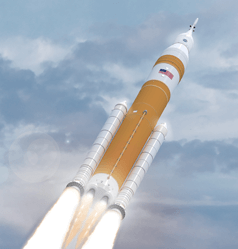
NASA’s powerful new rocket, the Space Launch System (SLS) will send astronauts aboard the Orion spacecraft nearly a quarter million miles from Earth to lunar orbit. Astronauts will transfer to a human landing system for expeditions to the surface of the Moon. They will return to the orbital outpost to board Orion again before returning safely to Earth.
Orion Crew Capsule
Launch Abort System
The Launch Abort System is designed to carry the crew to safety in the event of an emergency during the early seconds of a launch. The system can start within milliseconds to whisk the Orion capsule to safety. The crew can then make a splashdown using its parachutes for a safe landing. It is part of the Orion Crew Module.
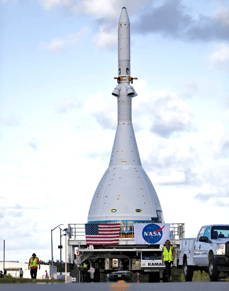
European Space Agency's Service Module (ESM)
ESA's Service Module provides the thrust to propel the Orion crew capsule out of Earth orbit towards the Moon after the ICPS sets the spacecraft into lunar orbit. The ESM is a complex system that provides thrust to the spacecraft and life support for the astronauts. It is part of the Orion Crew Module.
InterStage Cryogenic Propulsion System
The Interim Cryogenic Propulsion Stage (ICPS) provides the thrust to propel the Orion crew capsule out of Earth orbit towards the Moon after the solid rocket boosters and core stage have been expended. The ICPS is built by United Launch Alliance in partnership with Boeing.
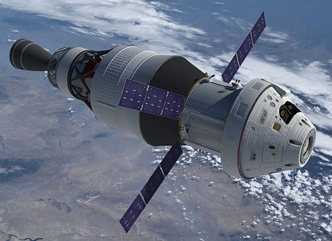
In this image, the ICPS is attached to the Service module to the Orion crew capsule.
Solid Rocket Boosters
The Solid Rocket Boosters are located on either side of the Space Launch System core stage. Based on shuttle technology, they are the largest, most powerful solid propellant boosters ever built. Each booster consists of five segments, one more than used for shuttle. They are 12 feet in diameter and are 177 feet long. These two powerful boosters provide 75 percent of the thrust at launch.
The Rocket - Space Launch System (SLS)
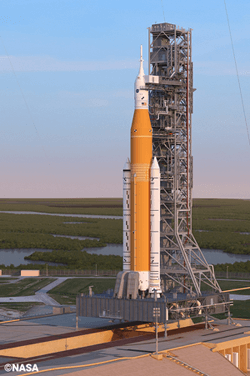
The SLS is a Super Heavy Lift Launch Vehicle (SHLLV), because it can lift over 50 metric tons of payload. SLS will actually be able to lift more than 95 metric tons to the Moon. The rocket is designed to allow additional functionality in future models, so the rocket that is intended for use in the first human launch of Artemis is designated Artemis 3. Boeing is the prime contractor for the design, development, test and production of the launch vehicle core stage, and the flight avionics or the systems that control the craft, including communications, navigation, and management of the many ystems of the rocket. The SLS being used for the first three Artemis missions is Block 1. A future, more advanced Block 1B is planned for additional Artemis flights.
SLS is a two-stage rocket. The lower stage is called the "core stage" and can be easily recognized by its orange color. This stage is also supported by solid rocket boosters (SRB) that are much larger than the ones that helped to launch the shuttle although they are based on that proven technology. The SLS rocket boosters have 5 segments instead of the 4 segments of the Shuttle's SRBs. The SLS core stage uses 4 RS-25 Engines. Unfortunately none of the engines or boosters are reusable, meaning the system is not cost effective. Hopefully that functionality can be added in the future.
The core stage has 2 huge propellant tanks. Together they hold 733,000 gallons of super-cooled liquid hydrogen and liquid oxygen. The core stage will weigh more than 2.3 million pounds when it is fully fueled. NASA estimates it will take 114 tank trucks to fuel the core stage.
SLS underwent a green hot fire test called Artemis-1 before being shipped to the Kennedy Space Center for final assembly and to be integrated with the Orion spacecraft. This test of the rocket’s core stage and its integrated systems is the last test before the rocket was moved from Stennis Space Center to Cape Canaveral. The test simulates the launch by loading the propellants and firing the four RS-25 engines together to demonstrate that the engines, fuel tanks and systems, and the software can all perform together as they will when the rocket is actually launched.
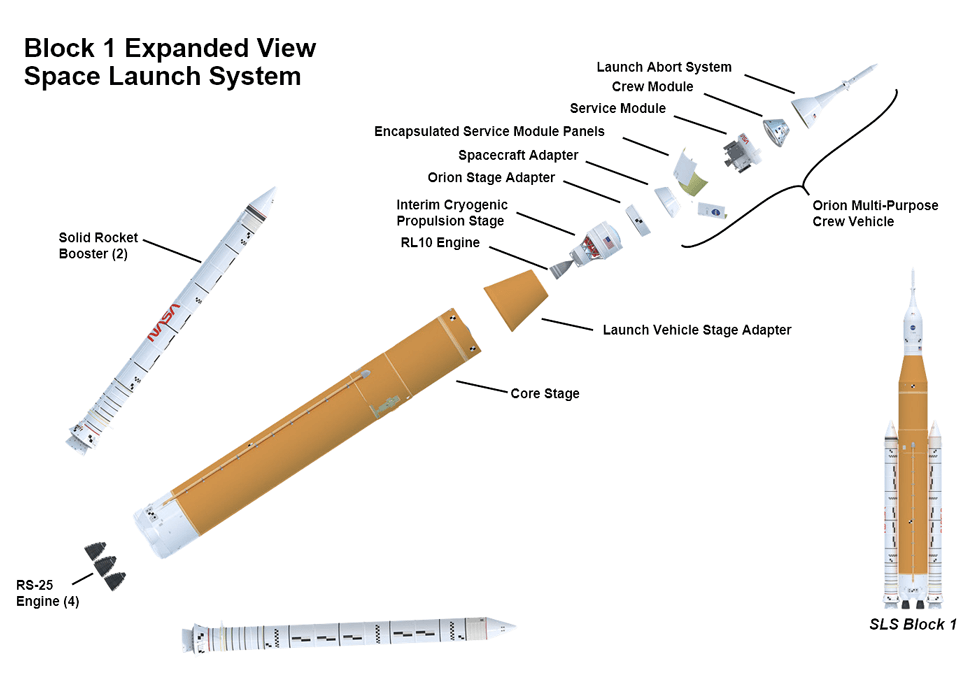
Space Launch System (SLS) Overview - - NASA website
#AstrasStargate #ImaRocketFan

Orion Crew Module
NASA’s Orion spacecraft is built to take the human crew to space for the Artemis program. Orion has emergency abort capability, life support systems that will sustain the crew during the space travel, and will keep the crew safe during re-entry from deep space. Orion is to launch on NASA’s heavy-lift rocket, the Space Launch System. Orion missions will launch from Kennedy Space Center on Launch Complex 39B.
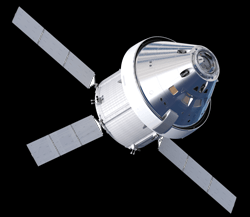
Orion consists of the Crew Module (CM), the Launch Abort System (LAS), the Service Module (SM), and the Orion-to-Stage Adapter. The Crew Module supports the astronauts and protects them when they return to Earth with its heat shield. The Launch Abort System will propel the crew module to safety in an emergency during launch or ascent. The Service Module was built by the European Space Agency. It contains Orion’s propulsion, power and life support systems. It will generate power using solar arrays, and provide thermal control, water and air for the astronauts. The Service module will be used until the Orion capsule returns to Earth, when it will separate from the crew module just before reentry. After the crew module reaches orbit, it drops off and the module continues to the Moon. The Orion-to-Stage Adapter connects Orion to the launch vehicle. The Orion Crew Module consists of the Orion Crew Capsule, the Service Module and the Launch Abort System.
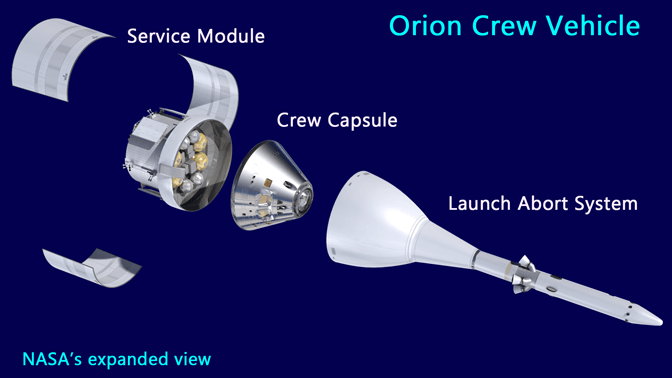
Orion Crew Capsule
Shown here attached to the Service Module, the Orion crew capsule is the home for astronauts while they are on Artemis missions, traveling to and from the Moon. The spacecraft provides ~330 cubic feet of living space for a crew of four astronauts up to 21 days. It has an advanced Thermal Protection System (TPS) or heat shield, that enables the vessel to survive a trip back through Earth's atmosphere. The spacecraft also provides radiation protection for the astronauts. It also has a toilet that suffered some issues during the Artemis-II flight.
Lockheed Martin is the prime contractor that built the Orion spacecraft. They also supervise Orion during mission flights.
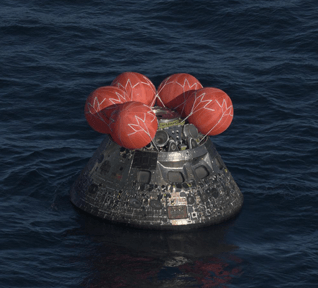
- Get the Orion reference guide from NASA.
Thermal Protection System (TPS)
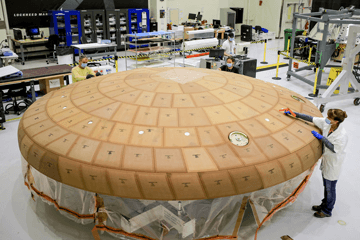
Orion's heat shield uses tiles of the ablative material, Avcoat, that was developed in the 1960s by the Avco Corporation (Aviation Corporation) for the Apollo program. Originally, the formula contained asbestos that had to be removed. In the image above, technicians inspect the AVCOAT heat shield for the Artemis II at Kennedy Space Center on July 2, 2020. NASA credit: ASA/Isaac Watson
Some Orion Testing History
The Orion capsule and its service module took a Super Guppy flight to NASA's Plumbrook Station landing on December 15, 2019 where it underwent simulated in-space conditions testing at the Space Environments Complex (SEC). Successfully passing all the tests, Orion took another Super Guppy flight Back to Kennedy Space Center on March 25, 2020.
NASA performed an uncrewed test flight, Exploration Flight Test-1 (EFT-1) to test Orion systems critical to crew safety - heat shield performance, separation events, avionics and software, attitude control and guidance, parachute deployment and recovery operations. The EFT-1 mission launched December 5, 2014, on a Delta-IV Heavy booster.
European Space Agency's Service Module (ESM)
The European Space Agency's Service Module provides the thrust to propel the Orion crew capsule out of Earth orbit towards the Moon after the InterStage Cryogenic Propulsion System has completed the TLI maneuver. The ESM is built by Airbus for ESA under contract. The ESM provides propulsion and maneuvers the Orion spacecraft using the Orion Main Engine, a refurbished orbital maneuvering engine that was originally used on NASA’s space shuttle. This engine can provide up to 6,000 pounds of thrust. In addition to its function as the main propulsion system for the Orion spacecraft, the ESM is responsible for orbital maneuvering and attitude control. The ESM also has 8 auxiliary thrusters mounted on the bottom of the vehicle that backup the main engine and also provide thrust for maneuvers. There are 24 smaller thrusters, clustered in banks of 4, that are used for attitude control. ESM carries 8.6 tons of fuel in total.
The Service Module provides life support for the crew by supplying water and oxygen, and regulates thermal control which is also a very important function. In addition, the Service Module has a role to play in case of an aborted mission, it jumps into action to help carry the crew safely away from the vehicle.
Launch Abort System
The Launch Abort System provides the thrust to propel the Orion crew capsule out of Earth orbit towards the Moon after the solid rocket boosters and core stage have been expended. The ICPS is built by United Launch Alliance (ULA) in partnership with Boeing.
The Launch Abort System is part of the Orion Crew Module.
⋆ ⋆ ⋆
Interim Cryogenic Propulsion Stage (ICPS)
The ICPS is a single-engine liquid hydrogen/liquid oxygen-based system that provides in-space propulsion. The ICPS has a liquid hydrogen tank, powering a RL10B-2 engine that produces up to 24,750 pounds of thrust. ICPS has electrical and mechanical interfaces that support the Orion spacecraft. ICPS also carried hydrazine bottles for additional attitude control. This propellant helps the ICPS make small flight changes.
The Interim Cryogenic Propulsion Stage (ICPS) provides the thrust to propel the Orion crew capsule out of Earth orbit towards the Moon after the solid rocket boosters and core stage have been expended. The ICPS is built by United Launch Alliance (ULA) in partnership with Boeing.
The ICPS is a single-engine liquid hydrogen/liquid oxygen-based system that provides in-space propulsion. The ICPS has a liquid hydrogen tank, powering a RL10B-2 engine that produces up to 24,750 pounds of thrust. ICPS has electrical and mechanical interfaces that support the Orion spacecraft. ICPS also carried hydrazine bottles for additional attitude control. This propellant helps the ICPS make small flight changes.
The ICPS takes the Orion Spacecraft out of Earth's orbit and sets it on a Trans-Lunar Injection (TLI) orbit, falling away shortly after it completes the maneuver. It is a modified version of Boeing's Delta Cryogenic Second Stage that were used on ULA’s Delta IV launch vehicles. These second stage vehicles have a 100-percent mission success rate, having launched 45 times in various configurations.
Solid Rocket Boosters (SRB)
The Solid Rocket Boosters provide much of the thrust when the SLS lifts off the pad. Each SRB has five segments. They use steel cases repurposed from cases used on previous space shuttle flights. The booster segments are manufactured by Northrop Grumman in Utah and transported to NASA’s Kennedy Space Center in Florida where they are stacked and prepared for launch. Engineers stack the twin SLS solid rocket boosters inside the Vehicle Assembly Building at NASA’s Kennedy Space Center in Florida.
The previous plan for Artemis missions involved manufacturing a new version of the solid rocket booster, but this may not longer be the case.
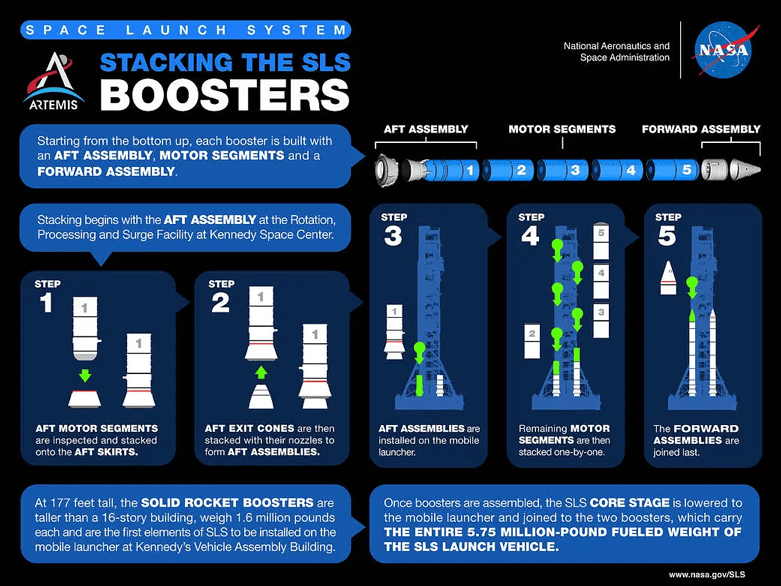
- - Use the link to read NASA's Space Launch System Solid Rocket Booster fact sheet
⋆ ⋆ ⋆
I'm a rocket fan! - - Astra
+ + Find out more about the Starship Human Landing System at Astra's.
Watch this NASA video (length 5:31) posted in December 2019 that explains the Artemis mission:

Starship vs. Space Launch System (SLS)
I've seen many comments over the years, complaining about SLS that are understandable. Yes, it was an expensive launch system to build and as of this writing still must prove that it will work. Many comments complain about the fact that NASA is going to trash the RS-25 engines that power the first stage of SLS. The typical comment is, "what a waste". But is it?
It is important to understand that the RS-25 engines were developed in the 1970's. Yes, that's correct, they were developed over 40 years ago. They were developed to launch the Space Shuttle into low Earth orbit.
So Artemis-1 launched with the following engines:
RS-25 Engine #2045 flew on 12 shuttle missions from 1998 through 2011.
RS-25 Engine #2056 flew on 4 shuttle missions from 2001 through 2006.
RS-25 Engine #2058 flew on 6 shuttle missions from 2007 through 2011.
RS-25 Engine #2060 flew on 3 shuttle missions from 2010 through 2011.
So why is using them one more time to launch people to the Moon such a big waste? After all, they could be rotting in the museums where the rest of the old Space Shuttle parts are on display. It would be nice if the engines could be recovered. This would add to the cost of the Artemis mission and the timeline would continue to be stretched out. These engines are at best over 10 years old, we should be glad to see them put to use again. Parts of the Solid Rocket Boosters SRBs are also utilized in the SLS design and people ask rightly why we don't retrieve them. NASA is working to enable the return of the SLS rockets to Earth in the future, so new engines would be reuseable.
The Space Shuttle was the first reusable spacecraft. If comparing Starship to any other launch system makes sense, it could be compared to the Space Shuttle. The problem with making this comparison is that the shuttle was also built in the 1970's--technology has come a long, long way since then. The Space Shuttle went into low Earth orbit. It could carry 7 astronauts who made repairs in space, launched satellites, and went to the ISS. In fact, without Space Shuttle, the large components of the station could not have been raised. And, while NASA successfully launched the Space Shuttle with large station modules, they didn't let large, spent rocket boosters careen around the Earth to land who knows where.
SpaceX's Starship HLS must be completed take the next humans to the Moon. NASA and SpaceX are working closely together because the launching of fuels to refuel Starship HLS must be tackled and solved. Starship itself will be fitted out with technology that will be human-rated when SpaceX takes NASA's astronauts to the Moon. I truly SpaceX will be able to catch the Falcon SuperHeavy booster on the same launch stand because that will make it easier to refurbish and turn around faster. It's an amazing feat of engineering that definitely comes from thinking out of the box. The pinpoint accuracy that SpaceX has demonstrated with the Falcon 9 and SuperHeavy recoveries is fantastic. A launch tower that can catch a returning Starship is something I can't wait to see!

Links to NASA Pages:
Orion Spacecraft - Taking humans to the Moon and Back
Orion Reference Guide at NASA
For detailed overview of the design, development, testing, and engineering of NASA's Orion spacecraft. For technical information on the Orion Crew Module go to the Spacecraft Components Encyclopedia on the site.
Space Launch System Infographics at NASA
Join the Artemis Mission to the Moon
- Family fun and educational activities, great for teachers and STEM educators. Join NASA's Artemis Student Challenges. Educators will find materials to use in their classroom. NASA also offers scholarship information.
This webpage is ©2026 D. E. Jenkins all rights reserved. Please use the contact page to get permission to use this content or to send comments or corrections.
Last Modified 07/13/2026


